Supporting EAL pupils reach better learning outcomes with a new assessment tool

Overview
The Heddle Assessment Tool supports EAL pupils and their teachers to reach better learning outcomes through tailored support
Around one in five children in UK schools speaks another language at home - that is close to two million pupils in England alone. Until now, their teachers have had very little guidance and support on how to help these students learn and progress.
Heddle, a University of Bristol spin-out founded by Dr Robert Sharples, was set up to change that. Turning a decade of classroom research into a tool to reliably assess English levels of each new student and give teachers tailored support to improve learning outcomes.
That's when they approached Unfold, partnering with us to scope, design and build the Heddle Assessment Tool (HAT) from scratch. It brings induction, assessment and reporting into one system, giving EAL leads tailored recommendations for each new arrival and MAT leaders a view across every school in the group.
 Peter
Peter
 Izzy
Izzy
 Ian
Ian
 Harry
Harry
 Cécile
 Chris
Chris
Challenges
- The HAT tool is a brand new product, with no previous workflows as a foundation: user flows, data modelling and scoring logic all had to be defined from scratch.
- Assessments are taken by children with limited English on whatever device the school has available – meaning the platform must be robust and flexible.
- Heddle needed to keep refining questions, scoring and recommendations as schools used the tool, so we needed to build a rules-engine rather than hard-coding assessment questions.
- A complex and highly stringent permissions management system is needed to ensure schools, trusts, classes, staff and pupils only have access to the relevant data.
Outcomes
- Scoped, designed and built the complete HAT platform, from discovery through to deployment.
- Built three connected rules engines, covering how pupils are categorised at induction, which assessment questions each pupil is served, and how results translate into a recommendation.
- Created a modular question framework so new question types can be added over time without disturbing what already exists.
- Gave Heddle full administrative control over questions, categories, rules and organisations, so the product can improve without a development cycle.
- Deployed serverless infrastructure that absorbs the September intake peak without paying for it year-round.
- Delivered multi-tenancy and a permissions management system to control access effectively.
- Produced a codebase and specification that give Heddle a clear route to market and future feature development.
So how did we do it?
Starting with understanding
We began with a discovery phase: three workshops to understand the business, the product and then map out the user flows in detail. These sessions allowed us to produce a technical specification with the architecture, a sprint plan, sketches of key screens and a costed breakdown of the build.
For an early stage business turning research into a commercial product, this was a vital step to both show we had a clear plan to realise their product vision but also provide confidence to investors and stakeholders alike.

Designing for a young audience with limited English
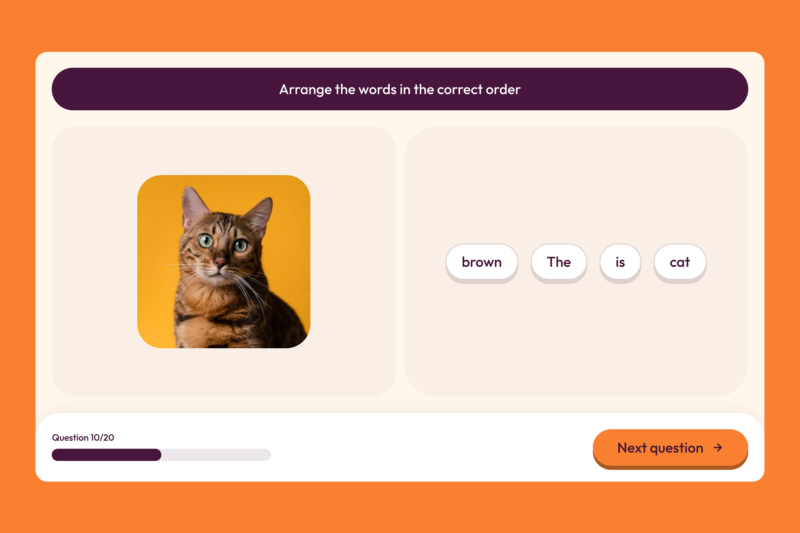
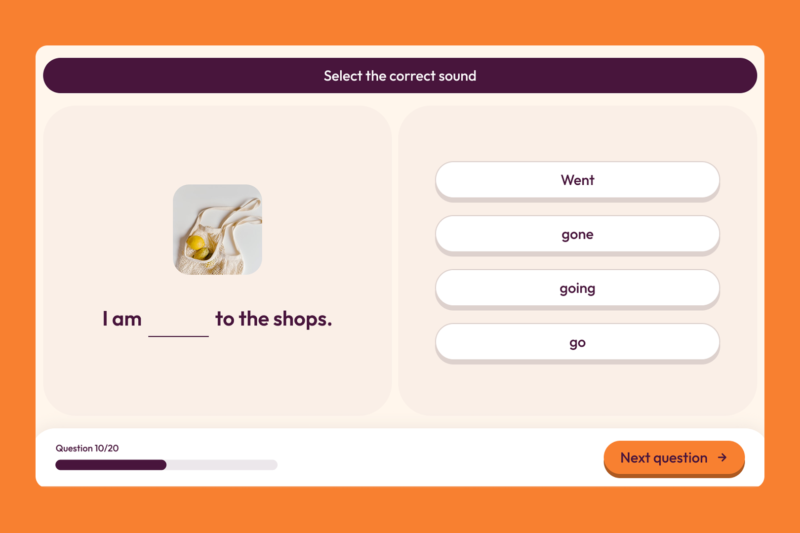
The person taking the assessment is a child who has little to no English, often working alone on a device that cannot be predicted in advance. This was a design challenge that required us to create an interface that was simple, intuitive and could be used effortlessly across a multitude of different device types and sizes.
We focussed on creating an uncluttered, friendly design with large target click areas so that they could be easily selected on both desktop and tablet devices.
Building in configurability
The hardest part was not the interface however, but the three rules engines underneath it.
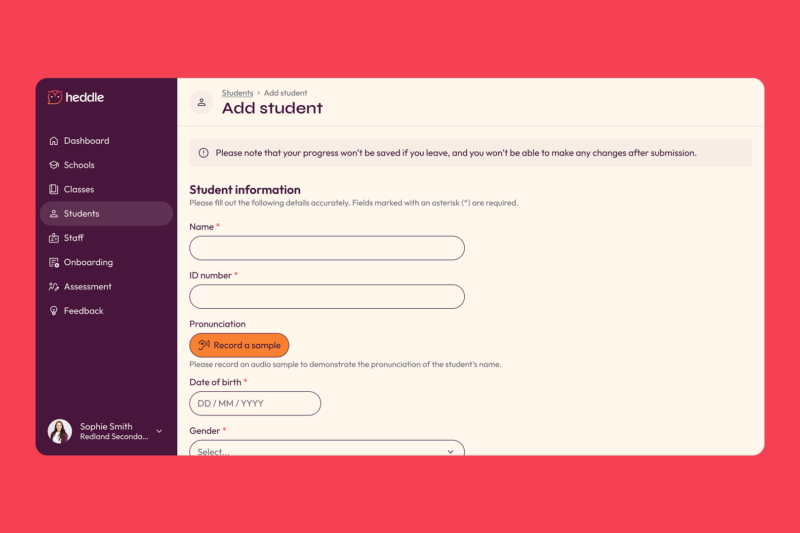
One reads a pupil’s language profile at induction and assigns categories, each with its own advice for the teacher. Another decides which questions that pupil sees, weighted across reading and listening and then blocked from repeating anything they have answered before. A third turns scores into a recommendation.
A key requirement of the project was that these rules could be configured by Heddle, not Unfold. Their value as a platform is in the research and the quality of the advice, so the platform had to let them keep sharpening both by allowing them to evolve the rules and assessment over time.
What comes next
We deliberately decided to keep version 1.0 of the product focussed, prioritising getting the product into the hands of teachers and pupils to help gather feedback and inform the future development direction. Launched at the start of the 2026/27 academic year we’re already thinking about the next areas such as speaking and writing assessments. Watch this space!

We'd love to hear from you
If you’ve got an idea for a new digital venture, email Harry for some honest, expert advice.
Get in touch